TOWN HOLLER
The Southeast Ohio Story Swap Project
Town Holler is a prototype of an interactive storytelling platform, archive, and podcast which augments the stories of Southeast Ohio through the oral tradition, and keeps those stories connected to the people and places they come from as part of a social practice.
MFA Communication Media Arts Thesis
Scripps College of Communications
Nicki Mazzocca | 2021
Introduction
I did not realize it at the time, but the inspiration for my thesis began in my very first semester of graduate school during Dr. Rachel Terman’s course, “Sociology of Appalachia.” For our service learning project, we were partnered with The Little Cities of Black Diamonds. LCBD is a history group that focuses on telling the stories of the Little Cities in Appalachian Ohio and community development. Our assignment was to research and present on a historic topic during their annual event, Little Cities of Black Diamonds Day. It was during this assignment that I realized how much I didn’t know about my own home region of Southeast Ohio.
At Little Cities of Black Diamonds Day, “Highlander Circles” are one of the main events. All who are interested sit in a circle and listen to each other’s stories. That afternoon, I learned more about the history and people of my region than I did in all my years attending grade school, high school, and obtaining my undergraduate degree in Southeast Ohio. This made me wonder why I had never heard these incredible stories, especially ones so connected to identity and place, and how I could use the skills I was learning in interactive design and sound production to augment these stories without losing the Appalachian element of oral tradition storytelling.
Three years later, all that wondering culminated in my thesis, “Town Holler: the Southeast Ohio Story Swap Project.” My goal was to prototype an interactive storytelling platform, archive, and podcast which is sustainable, accessible, and directly engaged with the Southeast Ohio community.
Artist Statement
I find ways to bring regional collaboration into my work and socially engage my community. I practice in many mediums, but specifically in theater, storytelling, audio production, graphic design, and interactive design. This allows for needed flexibility when working with communities to create something meaningful. “Town Holler” is a socially engaged practice that involves the community in social interaction through storytelling and a collaborative community audio collection. My aim is to create conversation in the community around identity and place through this social practice.
“Socially engaged practice, also referred to as social practice or socially engaged art can include any art form which involves people and communities in debate, collaboration or social interaction.”
Production Thesis
My production thesis for the Scripps MFA in Communication Media Arts is presented in three parts:
- My process, research, and the Story Swap social practice developed with the participation of my community.
- A UX case study, web design, & interactive prototype of the “Town Holler: The Southeast Ohio Story Swap Project” website to display how the community’s collected stories will be shared and archived, how participation is encouraged and promoted, and audio examples of how stories will be presented on the site.
- A beta version of my personal project as a socially engaged artist, the “Town Holler” podcast.
Table of Contents
Process
Goals
- Prototype a sustainable storytelling platform and practice that is accessible to the communities of Southeast Ohio with the participation of a community partner.
- Hold at least one Story Swap to test the viability of the social practice.
- Plan a personal project with the stories of the community.
Approach
- Social Practice
- Community Engagement and Participation
- Iterative & Holistic Design
- Qualitative Usability Testing
- Sustainability/Accessibility Prioritization
My Roles
- UX Researcher
- UI Designer
- Web Designer
- Artist
- Community Outreach
- Social Practice Designer and Facilitator
- Audio Editor and Producer
Tools
- Adobe XD (Prototype)
- Adobe Illustrator (Design)
- Adobe Audition (Podcast)
- Adobe InDesign (Host Guide)
- Zencastr (Remote Recording)
Research
Throughout my graduate career, I have researched the specific challenges and assets of my Southeast Ohio community. I continually attend regional conferences and workshops and learn from other community organizations, activists, and educators to gain a better understanding of what accessibility issues affect the larger Southeast Ohio region. It is important to my practice as an artist and interactive designer to understand these challenges so they can be addressed and considered during creation, but more importantly, to conceptualize solutions with our community assets in mind. One of those assets is our stories.
Even before I started classes at Ohio University, I knew my production thesis was going to involve Appalachian storytelling in some way. As I learned more about the region through my contextual courses in Appalachian Studies, and the great leaps being made in technology in my production courses, it made me wonder where our stories would end up. All of these great strides in communication were happening, but my region of Southeast Ohio (and the rest of Appalachia) still struggles to obtain access to basic broadband. I knew navigating this issue would be one of my major concerns of whatever my project was going to be, so I stopped fretting about the deficit and sought answers from my community’s greatest asset: its people.
Immersion in the Community

After being introduced to Little Cities of Black Diamonds in Dr. Terman’s course, I started attending council meetings and volunteering as much as I could. I lived in Chicago for ten years and when I came back home to Athens to go to graduate school, I was actively looking for a way to rejoin my community and be of assistance. The LCBD council was welcoming and inclusive. I was so impressed with how passionate every member was about preserving the history of the region, but also sharing those stories to build community and identity. I have been working with Little Cities continually for the last three years and am now a part of the council, primarily helping the history group with its digital storytelling.
I consider it a privilege to learn from and listen to the many historians and community activists who have been doing vital work in the community for decades, and I did so at every opportunity. Over time, I realized there was a common theme to many of the conversations at Little Cities meetings: getting the stories of the region “out there.” Through Little Cities, I met many other regional organizations who were running into the same roadblocks: lack of access, know-how, and resources to share their stories with a wider audience, with each other, and digitally preserve them for the future.
Community Partner
Tyler McDaniel goes by The Ohio and Appalachian History Geographer on social media, and is a council member of the Little Cities of Black Diamonds. It is an important part of my socially engaged practice as an artist to include a community partner in my work, and I could not have hoped for a better one than Tyler. As the host the first Story Swap for “Town Holler,” he was enthusiastic, engaged, and offered valuable insight into its organization and production.

the Right Home for "Town Holler"
After the first Story Swap, Tyler provided me with great insight on what information would have been the most helpful for him as a host. The third iteration manifested as “The Story Swap Host Guide,” and the “Five Easy Steps” on the website which lays out the practice for potential hosts as a short how-to manual.
This is the current iteration of the Story Swap, but my plan is to continue iterating learning from experience as I continue with this practice.
While this project is about process and design rather than coding and development, I wanted to make sure I was still designing with a future home in mind for “Town Holler.” It did not take me long to realize that in order for a project like “Town Holler” to be sustainable, the website would have to be built on a platform accessible to more than just web designers and developers. A content management system (CMS) is the solution to this problem because it will allow the layman to add stories to the website without having to dive into the code. This is essential for the longevity of the project, as I would like to bring more people into the “Town Holler” project whose backgrounds may not be in coding or web design.
CMS: OMEKA
During the research phase of this project I did a comparative analysis between a few leading CMS providers to see which would be the best platform for “Town Holler.” I based my analysis on the cost of the CMS, versatility templates, whether the CMS came laden with pre-installed and unnecessary plugins which would slow its speed to a crawl in a rural setting, and how archive-friendly the templates are. It became clear that Omeka would be the best CMS for this project for several important reasons, but primarily because it was developed specifically to curate and showcase digital collections. Omeka is open source and the user documentation is extensive and meticulous, but I would expect nothing less of a CMS developed by curators.
OMEKA
WORDPRESS
SQUARESPACE
PRICE
4/5
2/5
1/5
TEMPLATES
4/5
2/5
3/5
SPEED
4/5
1/5
2/5
ARCHIVE
5/5
3/5
2/5
TEMPLATE: CURATESCAPE
The Curatescape template serendipitously fell into my lap during a digital conference and exchange of ideas hosted by Ohio State University’s Center for Folklore Studies. During a panel about community development, the creators displayed their template and I immediately saw its potential for “Town Holler.”
Curatescape was created by professionals in the digital humanities to curate cultural content and is geared toward storytelling rather than showcasing. This is, of course, perfect for this project, but there are a few features that make it ideal:
- Users can search the archive not only by topic, but by interactive map which directly links stories to geographic place.
- Only uses very specific plugins so the website is not slowed by unnecessary data.
- The template is compatible with the Omeka web and mobile app, which allows stories to be accessed without being connected to the internet. This can remove some pain points for users who live in this mostly rural region and do not have good access to fast wifi or mobile service.
social practice
The Story Swap
Story Swaps are an informal, traditional storytelling platform where family, friends, or community members come together to swap stories with each other. Story Swaps can happen at organized events, during holidays, on the porch, at the dinner table, or anywhere that folks assemble to pass on information, tradition, and song. Because the whole point of social practice is to engage the community socially, I wanted to embrace Story Swaps as the basis for the “Town Holler” because they reflect how people tell stories and socially interact organically.
My overall goals while developing this practice were:
- The stories will be chosen by the community.
- The practice will be accessible and approachable for people living in both the towns and rural areas of Southeast Ohio.
- The practice will be sustainable for the community over time.
- Participants receive a copy of their story and continue to have full ownership over their story.
The practice went through three distinct iterations over the past year. Tyler, my community partner, and other community members were kind enough to provide feedback on whether they thought it would function in the community. The first iteration put too much of the onus on the community members and was too rigid in its format. It put too much focus on the quality of the recording and was too far removed from the original Story Swap format.
The largest shift came between the first and second iterations when Tyler and I started planning for the first Story Swap. It was during this time that the role of the “Host” solidified in the practice. The Story Swap Host would be a role in the practice played by a community member who picked the storytellers and theme of the story swap, thereby keeping the decision about what stories were being told in the community. The first iteration was scrapped almost entirely and we leaned into the informality.
It was during the second iteration that we held the first Story Swap and recorded the audio stories. This was held remotely due to the COVID-19 pandemic. Tyler asked local historians and community activists John Winnenberg, Jessica Cyders, Scott Moore, and Cheryl Blosser to tell a story about the preservation effort they were proudest of.
There were a few significant takeaways from our first Swap:
- Cheryl’s internet failed immediately and she was unable to attend, so we lost an important storyteller due to inaccessibility.
- The initial intention was for all Story Swaps to be in-person events, but the remote Swap ended up being very successful, save one unfortunate loss of a story. We decided that remote Swaps were viable and should be added to the practice as an option, and would also make the practice accessible to people who do not have access to reliable transportation.
- I had leaned too hard away from the rigidity of the first iteration and there wasn’t quite enough structure for Tyler, as host, to tell his storytellers what to expect.
Story Swap Audio Recordings
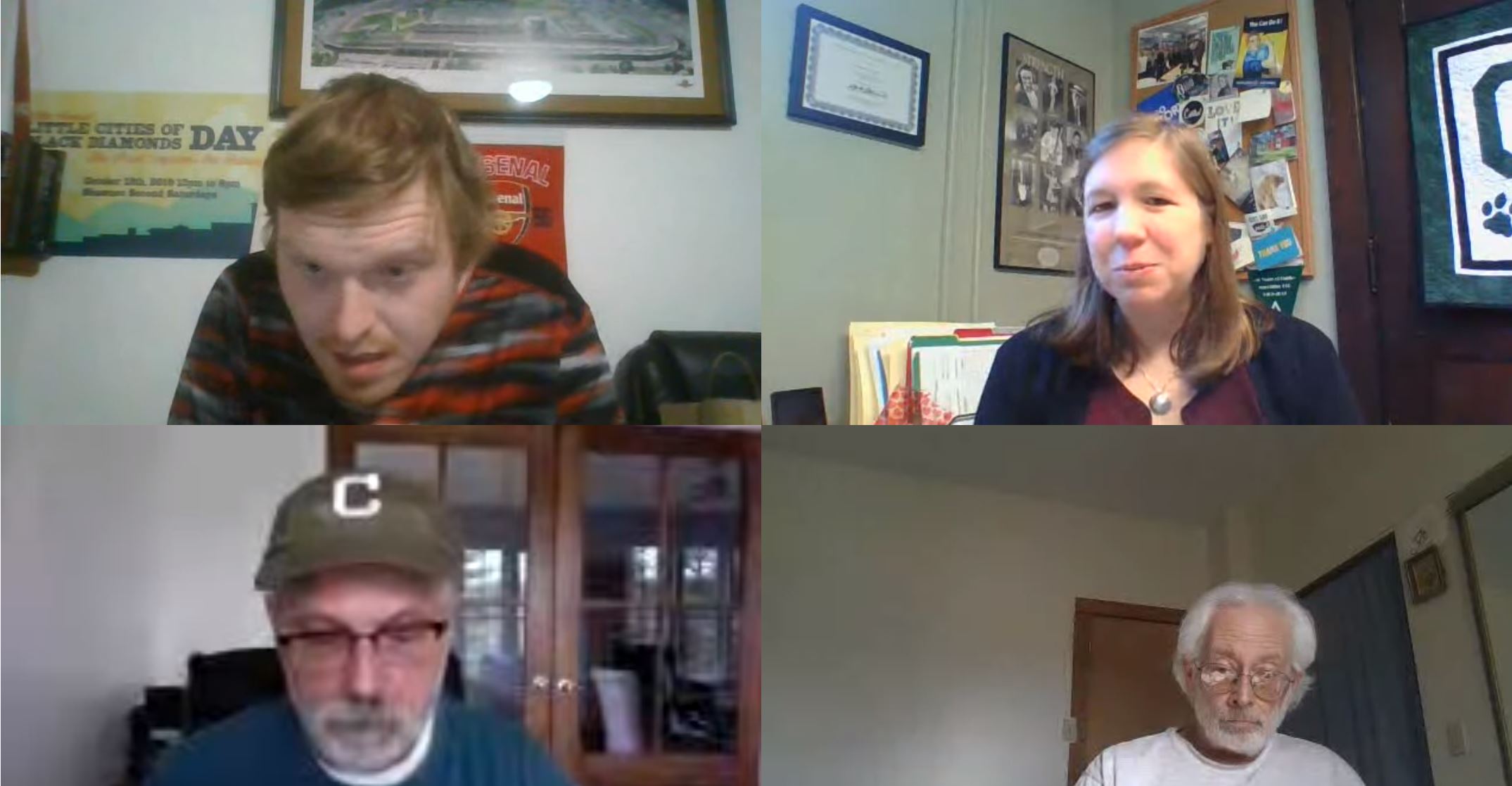
Upper Left - Tyler McDaniel | Upper Right - Jessica Cyders | Lower Left - John Winnenberg | Lower Right - Scott Moore
UX & Web Design
KEEPING IT SIMPLE
While designing the user interface, architecture, layout, and aesthetic for the “Town Holler” website I prioritized user accessibility and sustainability for longevity as a project. This meant I was always asking myself the following questions:
- Can my user navigate easily?
- Will this function slow a rural internet connection to a crawl?
- Is my user able to achieve their goal?
- Is this design easily replicable for future administrators?
Design Inspiration
From the very beginning, I knew I wanted to bring a lot of energy and life into the color and design of the “Town Holler” website. Appalachian and Southeast Ohio are often viewed in the media for what we don’t have, and I wanted my designs to reflect our natural assets.
I took a lot of inspiration from the long evening and morning walks I took during COVID lockdown. The sunrises and sunsets knocked my socks off on almost a daily basis, juxtaposed by verdant rolling hills.
Stylistically, I was inspired by the Works Progress Administration posters of the “See America” series. They capture the best parts of a specific place and time and display them in bold, bright colors.

Who Are Town Holler's Users?
Designing for Community
I created the following user personas based on the conversations I have been having with my community partner and my own research. Personas are a tool UX designers use to represent a large population of users based on behavior, motivations, experience with technology and software, etc.
Usually, when I create personas to track a user task or journey through the site, I have several archetypes to consider. However, the Curatescape template I have chosen has already been designed specifically for the user experience of historians, academics, and students. The archive usability was already programmed in. So I chose instead to focus on the usability needs of my two primary users: the Story Swap Host and the Story Swap Participant.


Architecture
SITEMAP

- Navigation of both the website and participating in “Town Holler” is clear and simple.
- Pages are inter-linked where possible for simple navigation and better “world building” for the user’s understanding of the website.
- The website’s architecture is “wide” rather than “deep.” In other words, I don’t want my users to have to go spelunking to find the information they want.
User Experience & User Interface
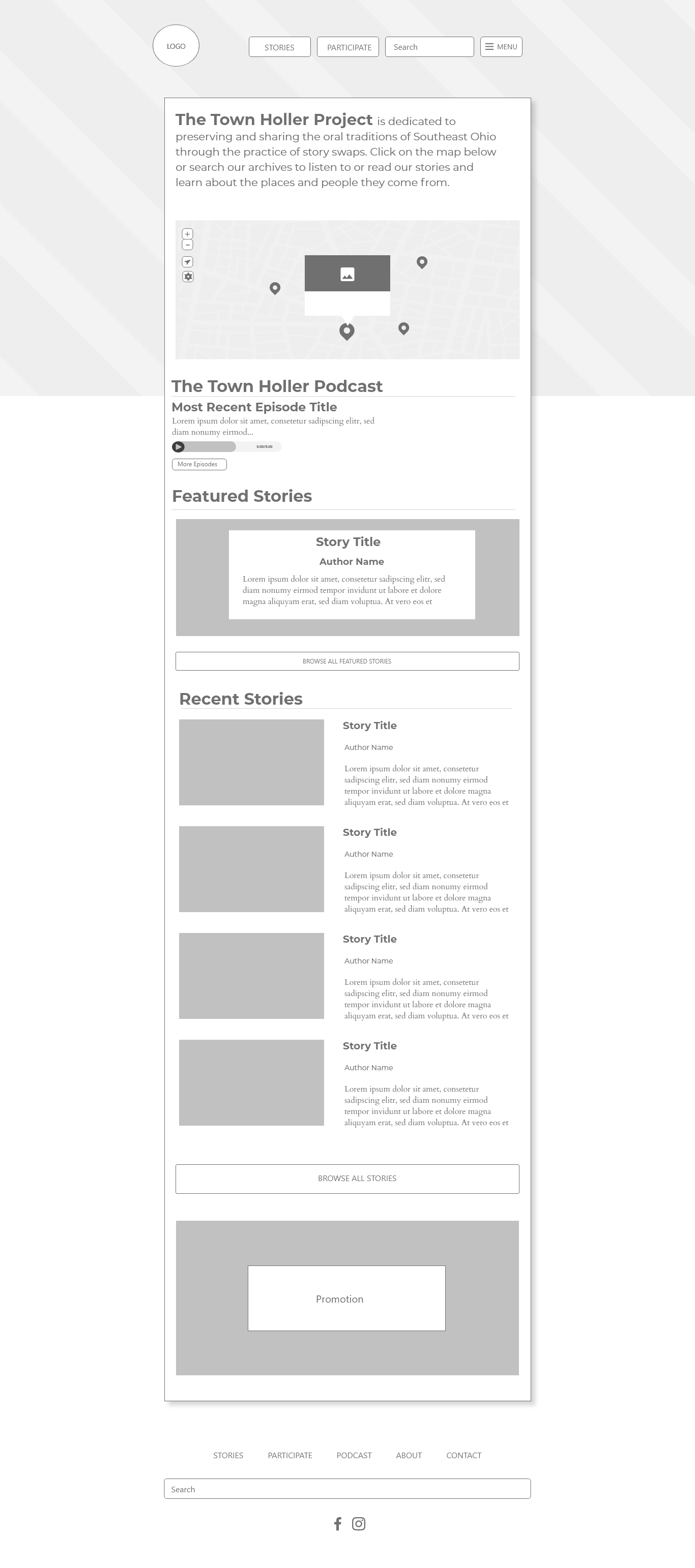
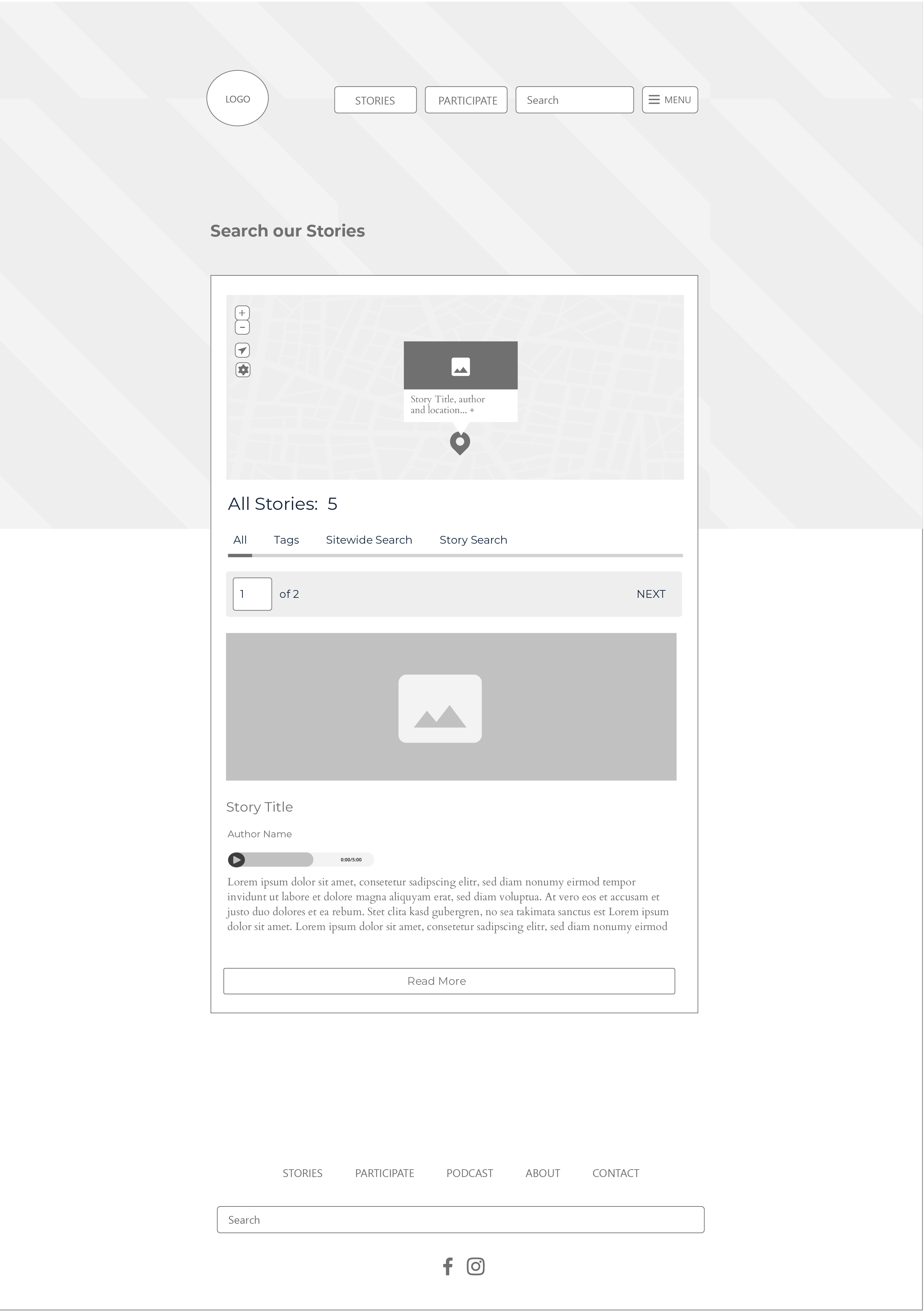
WIREFRAMES
I often find designing to the specifications of a preconceived template frustrating because it limits my freedom to create a carefully crafted layout for optimal user experience. The Curatescape template is fairly user-friendly already, but I felt a little boxed in by my options. However, it is the best template for the job.
This forced me to focus on the hierarchy of information, which was a challenge since “Town Holler” has a few different purposes:
- Share regional stories and connect them to the region.
- Promote and explain participation.
- Provide an easily searchable audio archive.
In the gallery to the right, you can see my wireframes reflecting the layout of the page. It looks deceptively simple, but when I was working on them I had the following user experience goals:
- Prioritize the sharing of stories.
- The user always knows where they are.
- Interactive elements are intuitive.
- Sections are distinct.
- Text sections are concise.
When I design for user experience, I try to prevent “info-dumping” from the get-go by breaking up text with images whenever possible, and breaking up text into more digestible sections while retaining readability.
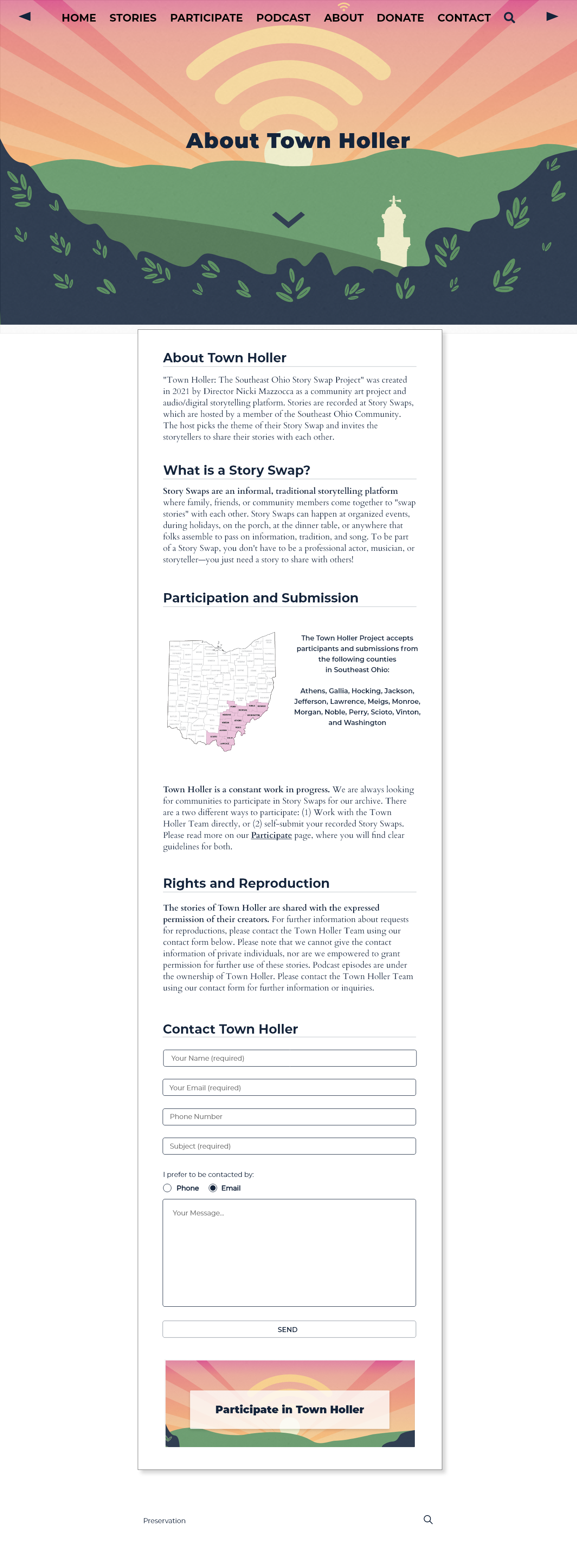
Once my wireframes were complete, I was ready to begin a mockup of the web design and user interface.



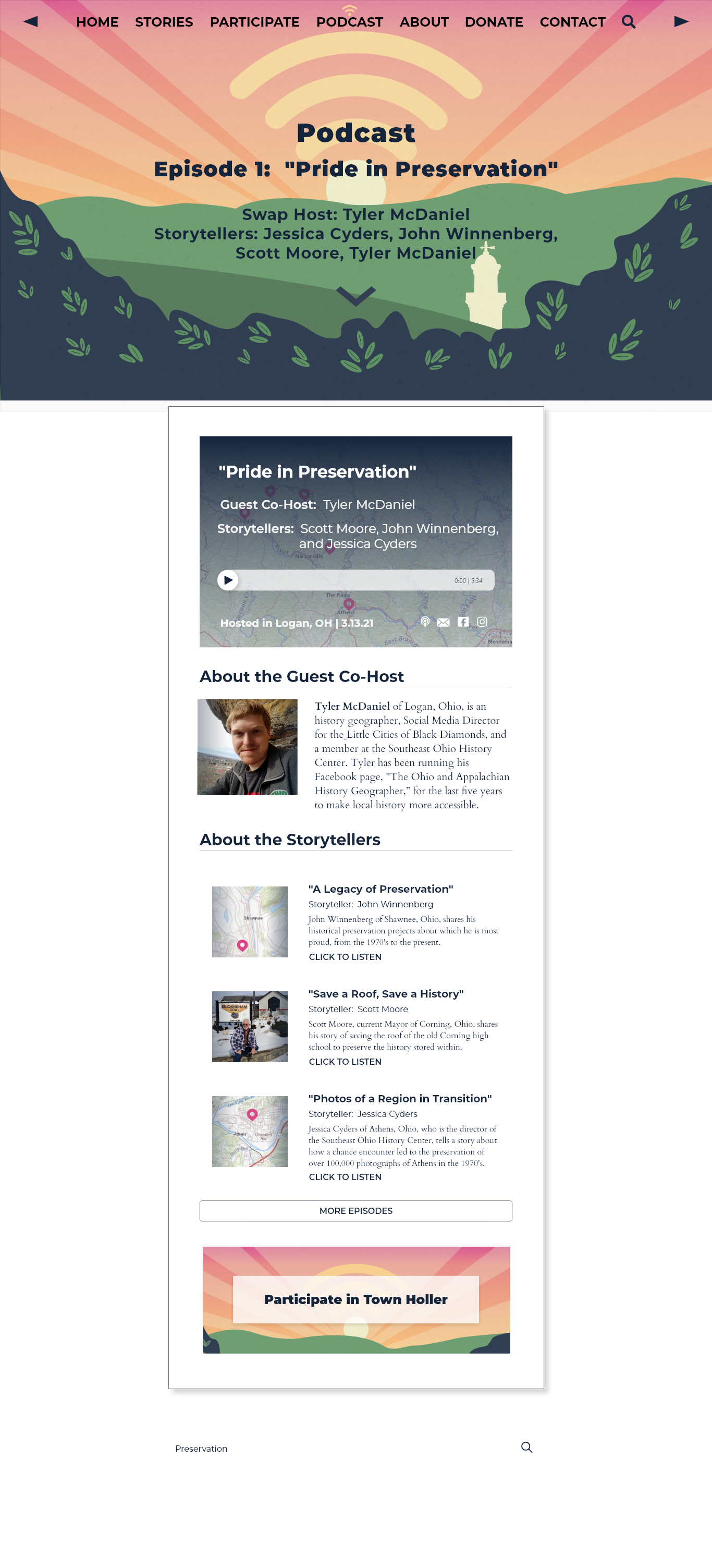
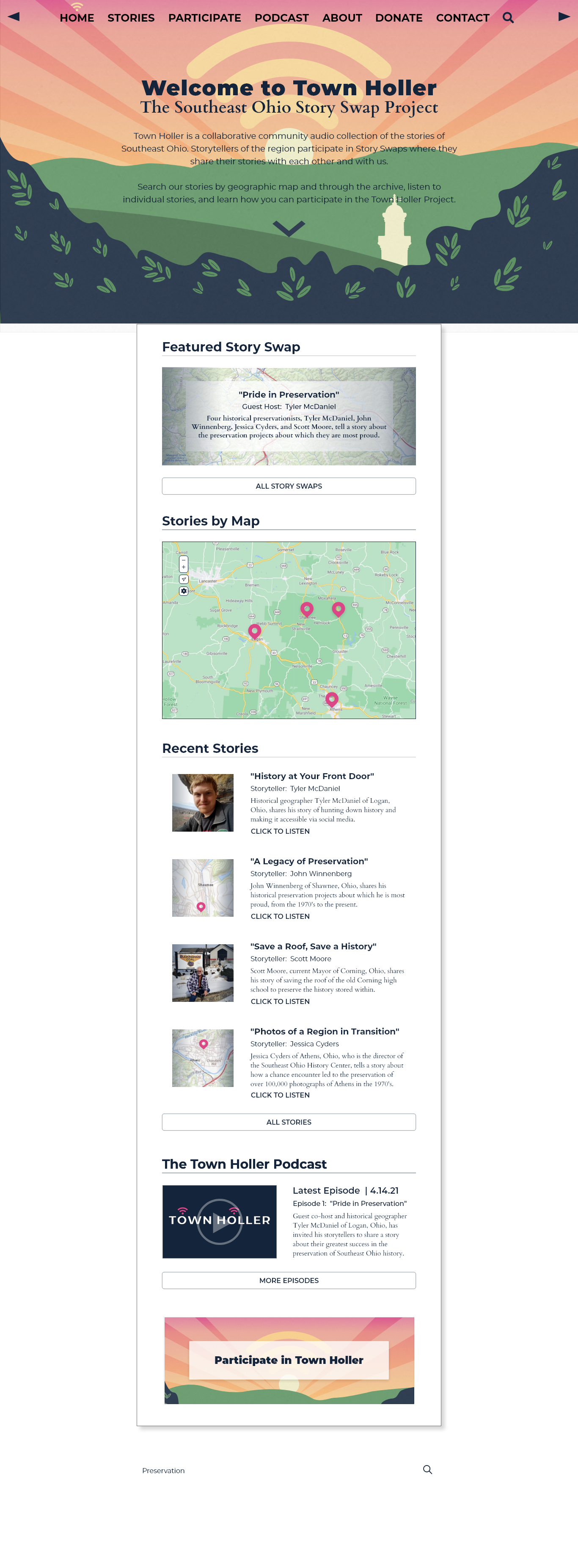
UI and Style Guide
Many community organizations become overwhelmed and frustrated with design. When designers are hired, they often leave them with no instruction on how to use the files they were given, or complex layouts made with software and fonts they can’t afford. They have very little agency.
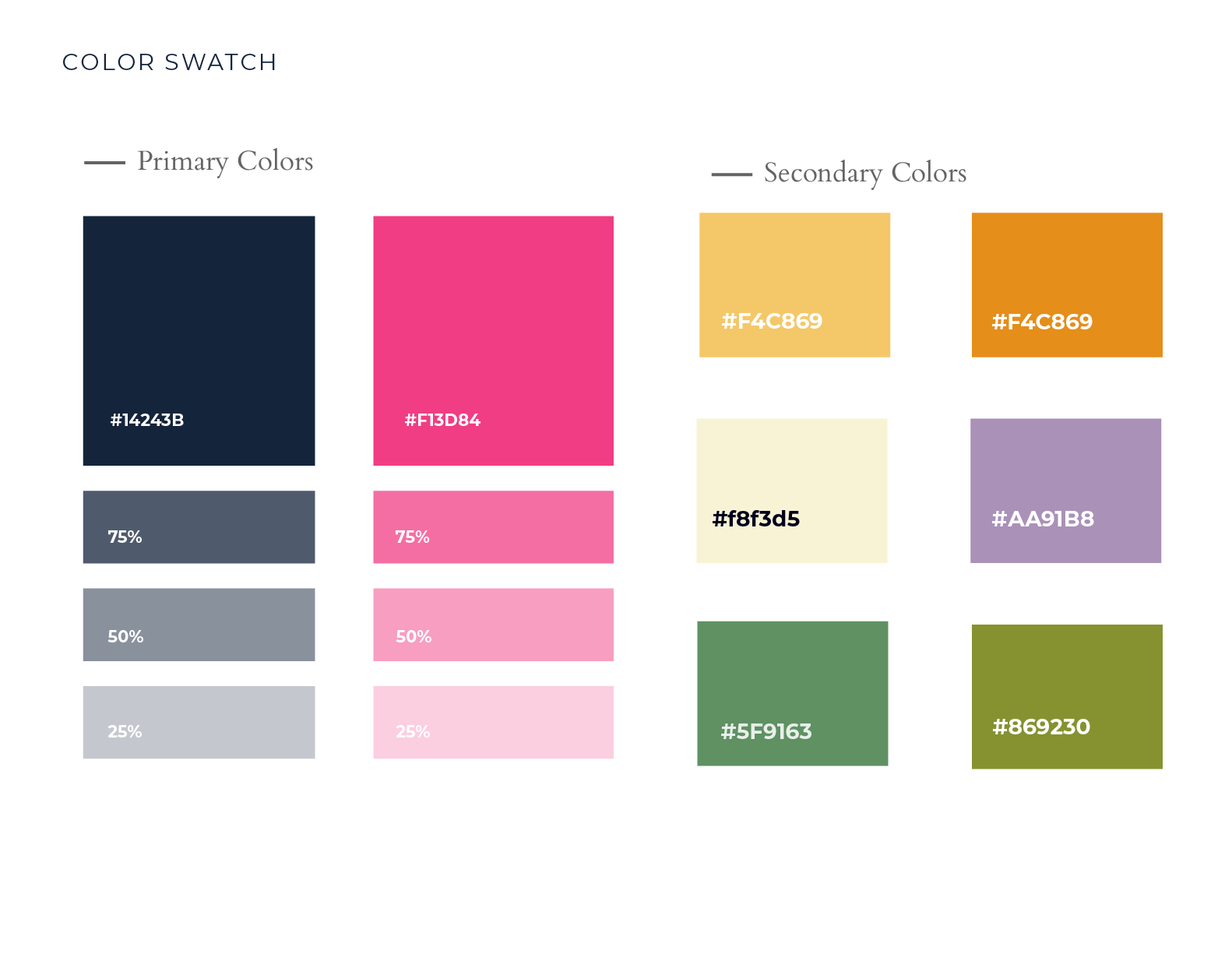
Sustainability influenced my design choices quite a bit. The fonts I chose are (Montserrat and Cardo) are free and available for any word processing software to make branding consistency across platforms affordable and simple.
Usability was, of course, the main influence on the UI design. The colorful palette I had planned to use in the center content column was too distracting, so I decided to focus on micro-interactions to indicate place and interactivity for the user.



PROTOTYPE
The prototype design probably went through more iterations than anything else. It’s like rehearsing a play in a rehearsal space for a month then suddenly getting on set and realizing your costume won’t fit through the stage door: There are always unforeseen issues when you first get into the space and start producing.
Below you will find an interactive high fidelity prototype, built in Adobe XD. You can navigate by clicking or tapping just as you would with any other website. Adobe does not, at the time of this project (2021) allow for anything but small sounds, so if you want to hear the Town Holler Podcast Episode, please click here.
USER TESTING
I chose to do remote qualitative user testing rather than quantitative user testing because that is overall the school of user research I find the most helpful. It can be tedious and is definitely more time-consuming than quantitative, but I find that the contextual and reactionary information that I receive at the moment to be invaluable to pinpointing issues with usability.
I recruited user testers who reflected my design personas. I then set up half-hour appointments on Zoom with each tester where I sent them the prototype link and had them share their screen. The testers were given a list of user tasks based on the user goals of the personas and asked to think out loud as they completed their tasks. After the completed tasks, I had them fill out a short survey of questions about the prototype.
Tasks
- Find the Participation page.
- Read the Participation page and find the Host Guide.
- Find the About page and return home.
- Navigate the Podcast Page and push play on Podcast.
- Navigate from Podcast Page to Stories Page. Return to the homepage.
- Find a story on the map and click on it. Find where to listen to the story. Find where to print the story. Find how to share the story on social media.
Completion Rate
- 100%
- 100%
- 100% (Delay)
- 100% (Delay)
- 66% (found with prompting)
- 100%
I was able to gain very valuable insights from watching the users navigate the site that I would not have received if I had just sent the survey. These insights were vital to the most recent prototype design iteration:
- The hamburger menu was causing a great deal of confusion and users hesitated to click on it and were instead looking for a “menu” title button.
- Users were not reading the landing information at the top of the homepage and missing information about the project because it was encased in the body column.
- Text on the story page intros was too small and forced users to squint.
Survey Questions
- What did you think about the website’s navigation? Did you find yourself navigating the main menu or within the content?
- Was it clear how to participate in Town Holler? If not, why?
- What is The Town Holler Project
- Did any of the elements of the website feel out of place? If so, why?
- What are your thoughts on The Town Holler Project? Do you think you would participate in it? Why or why not?
- What do you think could be improved?
Insights
- Navigation was confusing so most users looked for solutions in the content and found them.
- The term “host” was turned users off. One user said she would like to participate, but hosting sounded intimidating. This particular user has already organized a Story Swap of which she is the host, so that tells me that there is a language problem that needs to be addressed in my terminology of roles in the guide.
- Overall users left the page understanding what the project was, how it worked, and how they could participate.
User Quotes
Personal Project
The Town Holler Podcast
In social practice (or socially engaged art) the personal project of the artist heading the collaborative effort is secondary to the collaborative practice of the community. My initial goal was to only have my project planned by the end of my thesis. However, I was so inspired by the first Story Swap that I decided to begin my personal project of “The Town Holler Podcast.” I wanted to keep my project in the same medium that my community collaborators were working in, which is audio, and stretch my new skills in audio production. I also knew that one of the pain points for my community collaborators and users is getting their stories “out there.” This beta podcast episode, “Pride in Preservation,” is my response to the collaboration and discourse from three years of working with Little Cities of Black Diamonds and the Southeast Ohio community.
Conclusions
I am so grateful that I was able to spend the last three years focusing my areas of study in interactive design, sound production, and Appalachian Studies on my community, and to be able to culminate these new skills in my final project. I started my graduate career with a BFA in Acting, and my technological know-how peaked at being able to send an email. During my time in the Scripps MFA for Communication Media Arts, I have learned so much about the mediums of interactive design and sound production and the great potential this media has for community storytelling in a rural area.
Over the last year of working on “Town Holler,” I used the iterative and people-focused tenets of User Experience design to test the viability of the prototype and social practice I was creating. The time spent iterating this project with the input of my community partner has led me to the following conclusions concerning my initial goals:
- Prototype a sustainable storytelling platform and practice that is accessible to the communities of Southeast Ohio with the participation of a community partner.
- While I think it is too soon in the creation of “Town Holler” to say whether or not the platform and practice are one hundred percent sustainable and accessible, I do think it is on the right track. The practice of involving the community’s input and collaboration in its creation has allowed me to find and correct issues that I could not have foreseen or fixed without their input and expertise. Based on the results of this thesis, I think by continuing to follow this model through the life of “Town Holler” I will be able to continue fine-tuning this practice and platform as the project launches and grows.
- Based on the results of the testing, in the next iteration of “Town Holler,” I know I would like to tackle a few of the usability issues which the user testing highlighted, like the intimidating language used to describe the “host” role.
- Hold at least one Story Swap to test the viability of the social practice and record and edit first stories.
- This was more successful than I possibly could have hoped for during a pandemic. Even though I wasn’t able to test the in-person viability of the Story Swap practice, I did find an additional viable way of holding Swaps online. Even though this clearly has issues that were apparent during the swap, it ended up working really well.
- In future iterations and post-pandemic, I look forward to user testing the Story Swap social practice in person and learning from the experience.
- Plan a personal project with the stories of the community.
- The personal project was not intended to be created, only planned, by the end of my thesis and I ended up fully producing a podcast episode as part of an ongoing personal project.
The Future of Town Holler
My hope is that the “Town Holler” project will, over time, “thicken” the narrative of the Southeast Ohio region, and by extension Appalachia, by providing an accessible way for our communities to tell, share, and preserve their stories. The website prototype and practice prototype have been iterated and tested to the point that they are viable, if not perfect, and I will pursue grant funding to help with the following startup costs:
- a reliable website hosting service
- travel costs
- mics and mic stands
- audio editing software
In the meantime, I will continue the practice of “Town Holler: the Southeast Ohio Story Swap Project.” There are currently two Swaps scheduled in the next few months, and I currently have the time and means to continue facilitating, recording, disseminating, and transcribing stories for the storytellers of Southeast Ohio. This summer I plan to recruit community media makers who are also passionate about telling our region’s stories to join the Town Holler team and the Story Swap social practice.
“This is a GREAT opportunity to digitally collect stories, information, and histories of individuals and their lives in the region. I hope this carries on for many years.”
– Tyler McDaniel
My Thanks To...
GRADUATE COMMITTEE
Committee Chair: Kate Raney
Committee Members: Dr. Rachel Terman and Stan Alost
COMMUNITY PARTNER
Tyler McDaniel
SPECIAL THANKS
Josh Hoffman
Chad Reich
Brian Koscho
Mike Mazzocca
Megan Westervelt
Dr. Sam Dodd
THE LITTLE CITIES OF BLACK DIAMONDS COUNCIL
John Winnenberg
Cheryl Blosser
Scott Moore
Pat Anderson
Kellye Blosser
Grant Joy
Tyler McDaniel
Tiffany Arnold
Rachel Terman
Michael Iafrato
References
“About – Little Cities of Black Diamonds.” Little Cities of Black Diamonds, 2020. https://www.lcbdohio.org/about/.
“Appalshop.” Appalshop. Accessed March 9, 2020. https://appalshop.org/.
Billings, Dwight D. “Once Upon a Time in Trumpalachia.” In Appalachian Reckoning: a Region Responds to Hillbilly Elegy, edited by Anthony Harkins, Meredith McCarroll. Morgantown: West Virginia University Press, 2019.
Brashear, Ivy. “Keep Your ‘Elegy’.” In Appalachian Reckoning: a Region Responds to Hillbilly Elegy, edited by Anthony Harkins, Meredith McCarroll. Morgantown: West Virginia University Press, 2019.
Bubak, Susan. “How Storytelling Impacts Our Identities.” U of G News, July 20, 2015. https://news.uoguelph.ca/2015/07/how-storytelling-impacts-our-identities/.
Campbell, Donna M. “Local Color Writers.” Regionalism and Local Color Fiction. Accessed February 16, 2020. https://public.wsu.edu/~campbelld/amlit/lcolor.html.
Carter, Ennis. Posters for the People: Art of the WPA. Philadelphia, PA: Quirk, 2008.
Catte, Elizabeth. What You Are Getting Wrong about Appalachia. ♭2018: Belt Publishing, 2018.
Caudill, Harry M. Night Comes to the Cumberlands: a Biography of a Depressed Area. Boston, MA: An Atlantic Monthly Press Book, Little, Brown and Company, 2017. Eller, Ronald D. Uneven Ground: Appalachia since 1945. Lexington: University Press of Kentucky, 2013.
“Community Training.” StoryCorps. Accessed February 16, 2020. https://storycorps.org/participate/host/community-training/.
Frost, William Goodell. “Our Contemporary Ancestors in the Southern Mountains.” The Atlantic. Atlantic Media Company, January 25, 2019. https://www.theatlantic.com/magazine/archive/1899/03/our-contemporary-ancestors-southern-mountains/581332/.
Garrett, Jesse James. The Elements of User Experience: User-Centered Design for the Web. New York: AIGA, 2002.
Gaventa, John. Power and Powerlessness: Quiescence and Rebellion in an Appalachian Valley. Champaign: University of Illinois Press, 1982.
Helguera, Pablo. Education for Socially Engaged Art: Materials and Techniques Handbook. New York: Jorge Pinto Books, 2011.
Kaberry, Julie MPH, “Ethical and Practical Considerations in Community-Engaged Research (CEnR)” Training Modules. The CITI Program, 2019. https://www.citiprogram.org/members/index.cfm?pageID=147#view
Krug, Steve. Don’t Make Me Think, Revisited: a Common Sense Approach to Web Usability. Berkeley, CA: New Riders Pub., 2014.
Skinner, Daniel, and Berkeley Franz. “Community Conversation.” Not Far From Me: Opioids and Ohio. Skinner and Franz, 2019. https://notfarfromme.org/community-conversations/.
May, Roger. Looking at Appalachia. Accessed April 15, 2021. https://lookingatappalachia.org/.
McElroy, Justin, Travis McElroy, and Griffin McElroy. Everybody Has a Podcast (except You): a How-to Guide from the First Family of Podcasting. New York City: Harper Perennial, 2021.
Omeka. Accessed April 19, 2021. https://omeka.org/.
Rubin, Jeffrey, and Dana Chisnell. Handbook of Usability Testing: How to Plan, Design, and Conduct Effective Tests. Indianapolis, IN: Wiley, 2008.
Super, David A. “The Cruelty of Trump’s Poverty Policy.” The New York Times. The New York Times, July 24, 2019. https://www.nytimes.com/2019/07/24/opinion/trump-poverty-policy.html.
“The Appalachian Region.” The Appalachian Region – Appalachian Regional Commission. Accessed March 9, 2020. https://www.arc.gov/appalachian_region/TheAppalachianRegion.asp.
Theater, Roadside. “Roadside Theater, Art in a Democracy.” Story Circle Guidelines | Roadside Theater, Art in a Democracy, May 1, 2014. https://roadside.org/asset/story-circle-guidelines?unit=117.
The National Map – Advanced Viewer. Accessed April 15, 2021. https://apps.nationalmap.gov/viewer/.
“Web and Mobile App Framework for Curating the Landscape.” Curatescape. Accessed April 19, 2021. https://curatescape.org/.
2021 Nicki Mazzocca